C. Lee McKenzie

Young Adult and Middle Grade Author

  • Home
  • Young Adult
  • Middle Grade
  • Teachers & Parents
  • Appearances
  • Contact
  • About
  • Links
  • Blog

Self-Editing Tips and Hat’s Off to Angela Brown

December 8, 2014 By C. Lee McKenzie


Self-editing Tips

I’ve read a lot of articles on the editing process. They have a lot in common, but each writer has his or her own system. Here’s mine. I usually work from the big picture (things like character consistency) down to the details (punctuation). I have a checklist, and this really helps me to focus on specific parts of my manuscript, one step at a time. 
I’m not an “organized” writer, but I am an organized editor. I try. 
Here’s my checklist:
Plot: engaging, complex enough, hits the ground running, starts in right place, keeps moving forward, logical, no coincidence that should not be there.
Character: MC clearly established at the beginning, MC wants or needs something immediately, markers for characters clear and consistent, not one-dimensional has good and bad qualities, makes reader care, motivations clear and right for the story
Setting: appropriate for the story, described sufficiently, but not too much 
Dialogue: advances the story, appropriate for the characters, increases conflict, always clear who’s talking
Scenes: there are various kinds of scenes, all further the plot or reveal more about characters  or build tension
Point of View: Consistent, the right choice for telling this story 
Pacing: Any scenes that drag and might need to be deleted, places dialogue could be changed to increase pace, heighten tension
Tone: Consistent for story, consistent with each character
Conflict: Sufficient to keep story interesting, does it increase throughout the story until the climax
Balance: Description, dialogue, narration, scenes and chapters. 
I don’t worry about getting everything during each editing session. Sometimes I make a note to go back to something later, then move on with the editing part I’m focused on during that session. 
Sometimes I stop and do that edit, even though I’m focusing on another aspect of the story. In other words, I’m flexible about moving around the story to fix things that come up while I’m in the process.

Suggestions

Stock up on survival supplies. Mine include nuts and water. No wine. I sometimes write with wine, but I never edit with it. 
Try for an uninterrupted time. I find that the more I can stick with the story during editing, the better I am at catching problems.
Don’t feel that you’re the only writer who has wanted to throw out their book at this point, but don’t do that. Take a break, then come back to the job when you’re a bit calmer.

Be prepared for several sessions with that manuscript. You’re going to have to edit it a few times. Be thankful when you’re down to those details of punctuation, grammar, word choice, and repeated or words or phrases. That means you’re almost finished. Relax.

Hat’s Off Corner

For seventeen-year-old Macie Breen, life in The Colony is a daily norm of being the odd girl out, that is, until everyday predictable slams to a screeching halt. Forced to the capital city of Bliss, Macie’s life becomes a horrific unraveling as she confronts daunting truths about The Colony as well as who, or what, she really is. 


Buy links: Evernight | Amazon
Goodreads author page: http://www.goodreads.com/author/show/6476148.Angela_Brown
Angela Brown in the Pursuit of Publishness blog: http://publishness.blogspot.com/
Amazon author page: http://www.amazon.com/Angela-Brown/e/B009JJEX60
Facebook author page: https://www.facebook.com/AngelaLBrownWrites
Twitter: https://twitter.com/ALBrownwrites

Filed Under: Uncategorized Tagged With: Angela Brown, craft, hat's of corner

How to Ratchet Up Tension In Your Novel

June 16, 2014 By C. Lee McKenzie

What is tension? 

I love this definition: “Delicious moments of anxious uncertainty.” Doesn’t that grab you and make you want to create those kinds of moments in your stories? So how do you do that? 

  • You make your characters want something.
  • You create obstacles for them.
  • You don’t let them have what they want.
  • You keep them trying to get it. . .for a while.

To enhance this tension of WANTING BUT NOT GETTING, Carol Kilgore has added the TICKING CLOCK. A perfect tension heightener. With character trying to overcome obstacles against the clock, readers have to turn the pages, and that’s exactly what writers want.

By the end of a long evening working as a special set of eyes for the presidential security detail, all Kat Marengo wants is to kick off her shoes and stash two not-really-stolen rings in a secure spot. Plus, maybe sleep with Dave Krizak. No, make that definitely sleep with Dave Krizak. The next morning, she wishes her new top priorities were so simple.
As an operative for a covert agency buried in the depths of the Department of Homeland Security, Kat is asked to participate in a matter of life or death—locate a kidnapped girl believed to be held in Corpus Christi, Texas. Since the person doing the asking is the wife of the president and the girl is the daughter of the first lady’s dearest friend, it’s hard to say no.
Kat and Dave quickly learn the real stakes are higher than they or the first lady believed and will require more than any of them bargained for.
The kicker? They have twenty-four hours to find the girl—or the matter of life or death will become more than a possibility.

CAROL KILGORE
Crime Fiction with a Kiss
Carol writes grocery lists, texts to her family, new lyrics to old songs for her dogs, love notes to her husband, and novels for herself. And for you. In between, she blogs weekly at Under the Tiki Hut and is active on Facebook and Twitter.

She sees mystery and subterfuge everywhere. And she’s a sucker for a good love story—especially ones with humor and mystery. Crime Fiction with a Kiss gives her the latitude to mix and match throughout the broad mystery and romance genres. Having flexibility makes her heart happy.
You can connect with Carol and her books here:
BLOG . WEBSITE  . FACEBOOK . TWITTER . GOODREADS . AMAZON
*****
WRITE CLUB STARTS TODAY
*****
“Do what you have to do resolutely, with all your heart. The traveler who hesitates only raises dust on the road.”
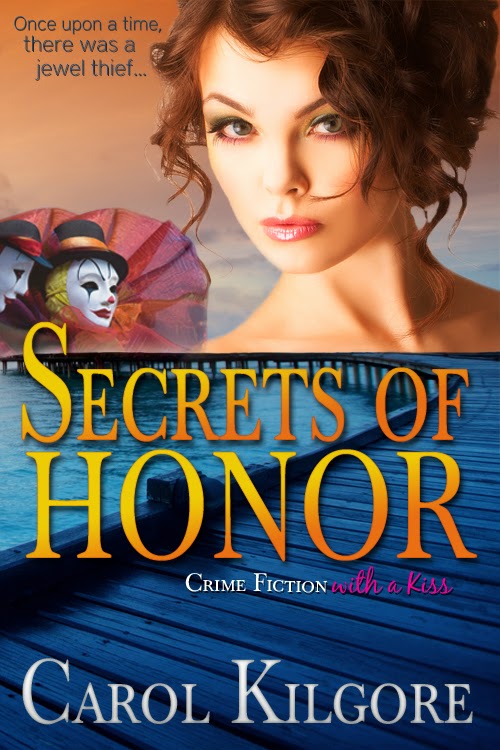
I’m guilty of hesitating and raising dust, but I’m working on being resolute.  How about you? And will you visit The Write Club today and cast a vote? I’m off to do that. Also don’t forget Secrets of Honor is waiting for you. 

Filed Under: Uncategorized Tagged With: Carol Kilgore, cover, craft

Monday Moods-Description Yet Again

June 25, 2012 By C. Lee McKenzie

Description should add to your story, not stall it. While I often fall in love with my description of a setting, I have to remember that my modern reader isn’t here to loll in the land of my beautifully executed prose about the countryside or seascape or quaint town or whatever. My reader is here to read a story and story is about forward moving characters and action. So how can I keep up my story’s momentum and yet put my readers into the place.

One way I’ve found is to treat the setting as if it were a character. Characters in stories have a purpose. They’re included to act as foils for each other or as companions that reveal each other’s contradictions or ambiguities. Setting can do the same things. Can you imagine Quasimodo hiding in a small wood framed church in the countryside? Isn’t the imposing cathedral bell tower and teeming Paris of the late 1400’s exactly what helps to make him and Esmeralda so memorable?


On a more modern note, Think how Louis Sachar’s Holes would fall flat if those holes were in a lush water-surrounded landscape. Doesn’t the desolate setting that the author describes add to the punishment that the delinquents suffer? I was thirsty the entire time I was reading that book and my thirst added to how much I empathized with those kids.

So how about rules for description? I’m not so good at following rules, but I love knowing them and I love being able to follow them because then I can break them real good.

Here are a few that I pay attention to while I’m thinking how to do things differently.

  • Include specific and carefully observed detailed. Example: the tree v. the thick limbed oak 
  • Reveal the innermost workings of your character. Example: She was cold and walked quickly across the busy street. v. Head down, hands shoved inside her pockets, she dodged the cars that clogged the crosswalk. 
  • Try to include different senses in a scene and never too many: His face was red with anger. v. His face, red with anger and his breath coming in hard pants, he raised both fists.
  • Don’t turn purple. Leave “It was a horrendously evil sight” where it belongs-with Bulware Lytton’s “It was a dark and stormy night.”
  • Whenever possible kill the adverbs. They lead to lazy, unimaginative writing. Example: He carefully unlocked the door. v. He turned the key in the lock, but stopped with his ear pressed against the door before he inched it open. 

Now I think I’d better go write some descriptive passages and see if I can do anything I’ve been sharing with you here. It’s so much easier to talk about how to write, then it is to actually write.

I’m sure you have some other ideas about description. If you have some tips, please leave them in a comment. I love to know what you do and I’m sure there are others who stop by who will also appreciate your insights.

Filed Under: Uncategorized Tagged With: craft, Description

Monday Moods-Adventurous & . . . still Crafty

June 18, 2012 By C. Lee McKenzie

“BREAKTHROUGH: “THE ADVENTURES OF CHASE MANHATTAN” BY Stephen Tremp, will be free for (2) days on Amazon June 18th - June 19th. Be sure to download your copy! You can visit Stephen’s Website Breakthrough Blogs for more synopses and reviews.

This looks adventurous, doesn’t it? Thanks for the visit, Stephen and good luck on your book.

***
 
Last week I returned to the CRAFT of writing, specifically DESCRIPTION. I love description in a story when it’s done right and creates the reality of the place and the people in it. But getting it right isn’t easy.  It takes a lot of practice and, I believe, a lot of reading.
One element in description that I love is figurative language: the simile and metaphor. The biggest mistake I’ve made and that others also make is falling into the lazy cliché trap. “He fought like a madman.” OR “Her eyes were deep blue pools.” 
 
Here’s some description that fell into that trap and, therefore, doesn’t work-at least for me. I’ll let you decide how you react to it. It will be interesting to find out if you agree or disagree with me.
 
He stood dead center in the field and listened to the mixed warbling of birdsong and the rustling sound of a breeze blowing through the tree tops. In the distance he heard the hum of traffic coming from the busy highway.
 
Whoever created the phrase “dead center” did so a long time ago. Any freshness vanished before I started reading books. So is there another way to say someone has arrived in the middle of something? How about, “He’d come half-way across the field.” Not terribly exciting, but all description doesn’t have to be exciting; it only has to put the reader into the place with your character(s), right? 
“Listened to” as it’s used here is one of those overused/abused filter words that I find dotting my first drafts all the time. I hate them, but I can’t seem to avoid them when I’m setting down a story. Thank goodness someone invented REVISION and gave writers a delete key. Take out those filter words and free your prose.
I always like a bit of detail in my description, and I don’t like having to figure out too much of the setting or where the character is located in that setting. In the example above, we have a field, but then are there trees in this field? It seems as if there are, so why not give that bit to us? And why not give us the kind of tree. That’s easy and it changes the feel of the setting. 
 
Why do birds have to “warble” and breezes “rustle” through tree tops? Couldn’t birds sounds come to the page differently? Could they just be birdsongs? Could leaves in a breeze just be that? I think letting the reader fill in what they sound like is a better choice here.
 
So now that I’ve deconstructed this bit of description, it’s only fair that I put it back together. This is one way I’d do it.

He’d come half-way across the field and stopped under the shade of an oak. The muffled drone of traffic coming from the highway was overlaid with birdsong and the fingers of a breeze playing through the tree top.
Okay, your turn. Maybe you’d like to DECONSTRUCT my version. There’s more than one way to build a good descriptive moment.


Filed Under: Uncategorized Tagged With: craft, Monday Moods

Monday Moods-Thankful and Crafty

June 11, 2012 By C. Lee McKenzie

My thankful Mood is all about my Mr. Linky experience. It has been great, and I’m now feeling as if I’m on my way to organized. I’ve set my book launch ahead a bit since there was a delay in production, but the delay won’t be long. Thanks to those who signed up to give me a hand and thanks to MPax for all her help with Mr. Linky as well the emails of encouragement. Lee at Tossing It Out, Rachael Harris and Alex Cavanaugh will still be hosting me, but in August.  Julie Muslie will host me in late July.

***

Now on to my Crafty Mood. I’ve been so tied up with the business of writing that I feel as though I’ve neglected the craft. I need to return to that and remember that launches are not possible without actual writing.

One thing I’ve been doing a bit more of is reading and paying close attention to how the stories I really enjoy pull me into their characters and the worlds these characters inhabit. I love the fast-paced action and the tight dialog, but I also like those quiet moments when the author DESCRIBES the characters and the setting for me.

Description is an important piece of a story, and to bring that story to life on the page requires such skill on the part of writers. They have to translate the sight, sound, smell and feel of the people and  places so the readers have access to them, have a sense of what the characters look like, how they’re experiencing something or being affected by it. And they have to do it without resorting to clichés-the bubbling brook, the attractive woman, the bustling city, the stinky socks or the meow of the cat.

Appealing to all the senses adds depth and reality and allows the reader more of a chance to really lose himself in the prose. Here’s one passage I love because it tackles two of our senses to deliver up the character.

“Zalatnick led me into the shop not as if I was a fellow looking for a job but as if I was a friend of a friend. I was sure the men in the shop could smell the difference.”

Here’s Stephen King on DESCRIPTION: “Thin description leave the reader feeling bewildered and nearsighted. Overdescription buries him or her in details and images. The trick is to find a happy medium.”

How true, Mr. King. The craft is all about knowing what to include and what to leave out. If the writer includes just the right amount, the left-out portion allows the reader to interact and become one with the story. This is such an incredible skill that I think I’ll be focused on it for a while, so if you visit here for the next few weeks, I’ll be writing about what I’m learning about DESCRIPTION.

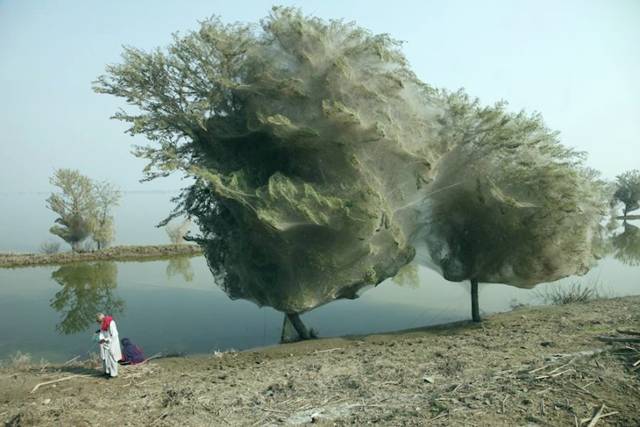
What brought this post on were these pictures of spider-webbed trees, an unexpected side-effect of the flooding in parts of Pakistan earlier this year. It seems millions of spiders escaped the rising waters and stayed among the branches, creating these surreal images. When I saw them I wondered how I’d put something like this into words. My first try was to call these trees captured by smoke. How would you describe what you see if you were writing a description of these trees?

Filed Under: Uncategorized Tagged With: craft, Monday Moods

https://www.youtube.com/watch?v=h59dYGrVQvs

Blogroll

  • Alex J. Cavanaugh
  • Author, Elizabeth Mueller
  • Beth Camp
  • Bish Denham
  • Book A Day Book Reviewer
  • Book Sage Reviewer
  • Bookd Out
  • Cathrina Constatine
  • Christine Rains - Writer
  • Damyanti Writes
  • Denise Covey
  • Deniz, Girdle of Melion
  • Diane Burton
  • elements of emaginette
  • Elephant's Child
  • Elizabeth Craig
  • Erika Beebe
  • Evernight Teen
  • Everyday Writer, Tyrean Martinson
  • Everything Must Change
  • Fiction Books Book Reviewer
  • Fundy Blue
  • H.R. Sinclair
  • Insecure Writer's Support Group
  • Joylene Butler, Suspense and Mystery Author
  • JQRose Book Blogger
  • Just Jemi
  • Laws of Gravity
  • Lee Lowery Murder Mystery
  • Leslie Moon, Moonduster
  • Literary Rambles
  • Loni Townsend
  • Mama Diaries
  • Michael De'Gesu
  • Musings
  • My Hogwarts Sabbatical
  • My Pet Blog
  • Nick Wilford, Speculative Author
  • Oh Look Another Book
  • Olga Godim
  • Patricia Lynne, Independent Author
  • Pensive Pens
  • Play Off The Page
  • Positive Letters …. inspirational stories
  • Reader Buzz Book Reviewer
  • Sandra's Blog
  • Shady Dell Music & Memories
  • Shooting Stars Mag
  • Sonja Droga
  • Storey Book Reviews
  • Straight From The Library Librarian
  • Susan Says
  • Tara Tyler Talks
  • The Secret Files of Fairday Morrow
  • The ToiBox of Words
  • The Warrior Muse
  • Thoughts in Progress
  • Welcome to My Magick Theatre
  • Word Pop by Yvonne Ventresca
  • WordDreams…
  • Writer In Transit, Michelle Wallace
  • Writing In The Crosshairs
  • Yvette Carol

Find Lee Online:

Email Facebook Twitter

LinkedIn GoodReads Google+

Archives:

Recent Comments:

  • Mark Noce on Hello, First Wednesday of 2022…oops! 2023
  • Elizabeth Seckman on Hello, First Wednesday of 2022…oops! 2023
  • Yvonne V on Hello, First Wednesday of 2022…oops! 2023
  • C. Lee McKenzie on Hello, First Wednesday of 2022…oops! 2023
  • C. Lee McKenzie on Hello, First Wednesday of 2022…oops! 2023

Tags

2009 Deb Blog Tour 2009 Debs' Tour 2013 A-Z Blog Challenge Alex Cavanaugh Alligators Overhead Arlee Bird AtoZChallenge2015 AtoZChallenge2016 Blog Hops Book Signings C. Lee McKenzie Christmas Contest cover Damyanti Double Negative Email Connect Halloween hat's of corner Heather M. Gardner Her Grammarness Insecure Writer Interview IWSG Jeremy M.J. Joachim marketing Middle Grade Monday Monday Miscellany Monday Moods New Books Nicole Ayers Pam Small Things Hop Stephen Tremp Story Collection Throes of Thursday Tina WEP WIP writing YA Young Adult